
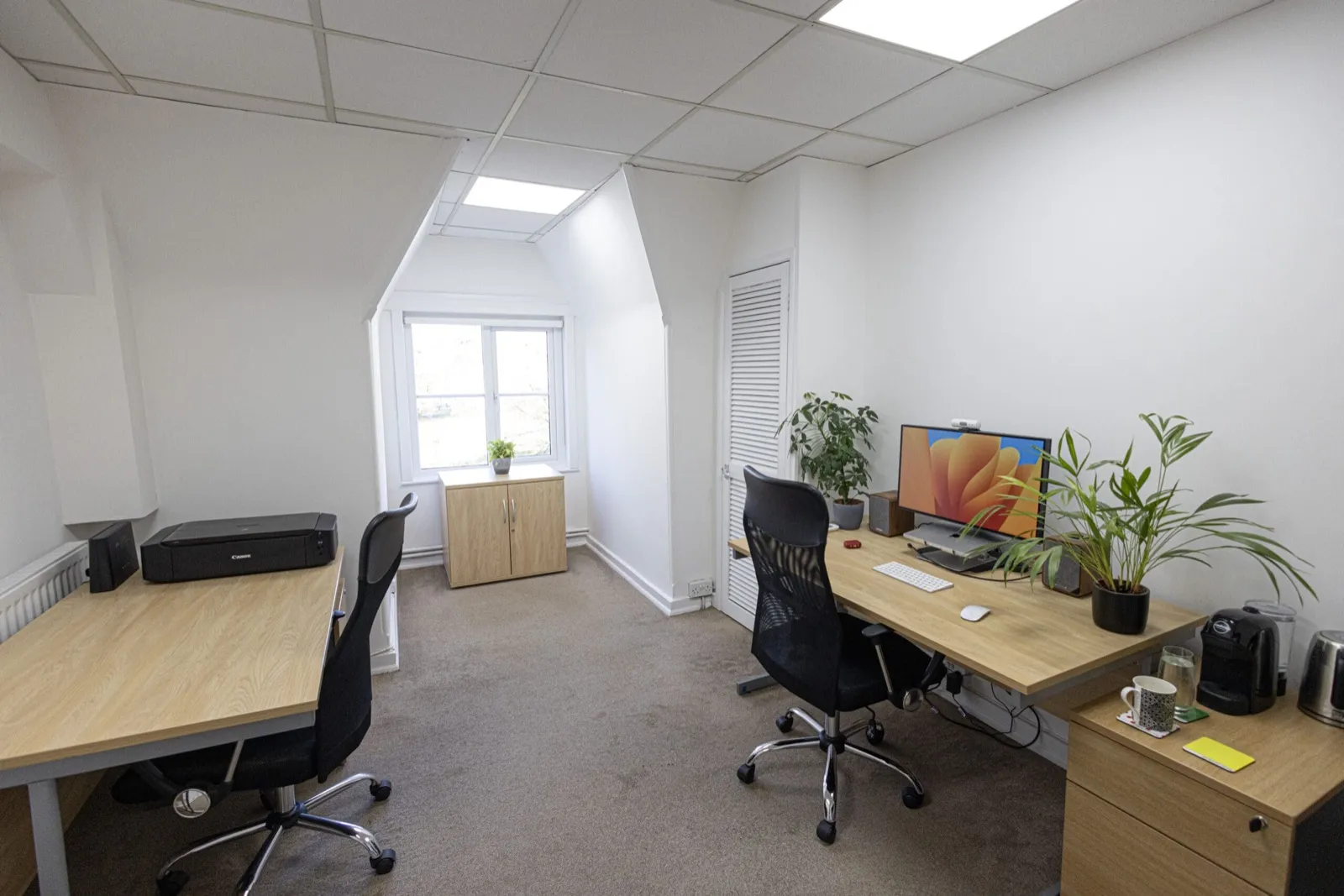
A serviced office is a furnished room in a shared building that you rent by the month. A managed office is a private floor or suite, fitted out to your brief and run for you by a provider on a one to three year contract.
A leased office is space you rent straight from the landlord, usually for five years, and fit out and run yourself.
For a team of one to eight people, a serviced office is almost always the right answer. A managed office starts to make sense at around 20 desks, and a lease pays off for a settled business that can commit for years.
We let serviced offices at Index House in Ascot, so we have a side in this. We have also watched enough teams sign the wrong thing to be honest about where serviced space stops making sense.
Serviced vs managed vs leased: the short answer
The three options differ on four things: who runs the building, how long you commit, how much cash goes in up front, and whether you share anything with other businesses. Serviced is the shortest commitment and the most shared; a lease is the longest commitment and entirely yours; a managed office sits between them.
Here is how they compare, using figures published by Hubble, Stoneway and CBRE.
| Serviced office | Managed office | Leased office | |
|---|---|---|---|
| What you get | A furnished private room in a shared building | A private floor or suite fitted out to your brief | Empty space you fit out yourself |
| Who runs it | The operator | A provider, to your specification | You |
| Typical size | 5 to 100 desks (Stoneway), from one person at some buildings | 20 to 500 desks (Stoneway) | 50 to 100,000 sq ft (Stoneway) |
| Minimum term | From one month (Hubble); 3 to 24 months is common (Stoneway) | 1 to 3 years (Hubble); usually 2 years (CBRE) | Typically 5 years, often with a break in year 3 (Stoneway) |
| Time to move in | Days, if a room is free | Weeks, while the space is fitted out | 3 to 6 months to complete the lease (Hubble), then the fit-out |
| Deposit | 1 to 2 months’ rent (Stoneway) | 2 to 3 months’ rent (Stoneway) | 3 to 12 months’ rent, depending on your accounts (Stoneway) |
| Monthly bill | One fee for the room and shared services | One all-inclusive fee (CBRE) | Rent, plus rates, service charge, utilities and everything else |
| Shared with others | Reception, kitchen, meeting rooms | Usually nothing | Nothing |
The pattern is simple. The more of the building you want to yourself, the longer you commit and the more cash you put down.
What is a managed office?
A managed office is a private office, usually a whole floor or suite, that a provider fits out to your layout and branding and then runs for you for an all-inclusive monthly fee. CBRE describes it as a hybrid between a serviced office and a traditional lease, and contracts usually run for one to three years.
In CBRE’s words, a managed office gives a business ‘exclusive use of a private office on flexible terms and an all-inclusive monthly fee’. The provider handles the fit-out, cleaning, maintenance, IT support and facilities, so you get a space that looks like your own headquarters without employing a facilities team.
What you do not get is anyone else in the building’s kitchen or meeting rooms. Everything inside the front door is yours.
That privacy is the point, and it is also the cost. The provider is building a space around one company, which is why Stoneway puts the typical managed office at 20 to 500 desks and why contracts start at a year or more.
Who a managed office suits
A managed office suits a company of 20 people or more that wants its own branded space, its own meeting rooms and a predictable monthly bill, but does not want to sign a five-year lease or manage contractors. Think of a regional office for a larger firm, or a scale-up that has outgrown shared space.
It rarely suits a team of five. Most providers will not fit out a suite that small, and if they do, you pay for a fit-out spread across a short contract.
What is a serviced office?
A serviced office is a furnished private room inside a building run by an operator, rented on a monthly fee that covers the room and the shared services around it. You share the reception, kitchen and meeting rooms with the other businesses in the building, and you can usually move in within days.
We have written a fuller guide to what a serviced office is and what is included, so here is only the part that matters for this comparison.
At Index House, rooms run from 140 sq ft at £795 a month plus VAT, for one or two people, to 622 sq ft at £3,350 a month plus VAT, for a team of eight. Every room comes furnished, with reception, mail handling, bookable meeting rooms, the kitchen, 24/7 access and free on-site parking.

The trade-off is that the building is not branded as yours. Your name goes on the door and the board in reception, but the hallway, kitchen and meeting rooms are shared.
What is a leased office?
A leased office is space you rent directly from the landlord on a conventional lease, usually for five years with a break clause, and then fit out, furnish and run yourself. It gives you the most control and the lowest bare rent per square foot, in return for the longest commitment and the most upfront cost.
Hubble says long-form leases commit you for five to ten years, with shorter-form leases starting at 18 months to three years. Stoneway says the most common arrangement is a five-year term with a break in year three.
The rent is only the start. On a lease you also pay business rates, a service charge to the landlord, utilities, insurance, cleaning, internet, furniture, the fit-out and your solicitor’s fees.
Then there is the exit. Stoneway estimates dilapidations, the cost of returning the space to its original state when you leave, at £15 to £25 per sq ft.
Managed office vs serviced office: what is the difference?
The difference is privacy and commitment: a managed office is a whole suite fitted out for your company alone, on a one to three year contract. A serviced office is a furnished room in a shared building, on terms that can start at one month, with the reception, kitchen and meeting rooms shared with other tenants.
Size decides most of it in practice. Below about 20 people, the managed option tends not to exist, because providers will not fit out a whole suite for a team that small.
In our experience, above about 30 people serviced offices start to look expensive per desk, because you are paying for a share of shared facilities you could run yourself.
What each option costs a five-person team
For a team of five, the realistic comparison is a serviced office against a small leased suite, because managed offices are rarely offered at that size. On bare rent the lease looks cheaper; once you add rates, service charge, fit-out, furniture, deposit and dilapidations, the gap narrows and the commitment grows.
Take a 415 sq ft room, which suits five or six people according to our office space per person guide.
Serviced, at Index House. £2,395 a month plus VAT, furnished, with reception, meeting rooms, the kitchen, 24/7 access and parking for you and your visitors. Move in once terms are agreed.
Leased, in Bracknell. Conventional offices there were listing at £27.50 to £31.50 per sq ft a year in October 2026, as set out in our guide to Bracknell office rents. At £28 per sq ft, 415 sq ft is £11,620 a year, or £968 a month in rent alone.
On top of that £968 come business rates, the service charge, utilities, cleaning, internet, furniture and a fit-out. You would also put down a deposit of three to 12 months’ rent, and set aside £6,225 to £10,375 for dilapidations at the end, using Stoneway’s £15 to £25 per sq ft.
There is a practical problem too. Small leased suites are hard to find: in Bracknell, Maxis 2 on Western Road starts at 3,663 sq ft.

Which office type should you choose?
Choose by team size and how far ahead you can plan: teams of one to about 15 usually do best in a serviced office, and somewhere around 20 desks a managed office becomes available and often good value. A lease pays off for a settled business of 30 or more that can commit for five years and wants full control.
Here is the rule of thumb we give people who ask.
- One to eight people, or unsure of headcount in a year. Serviced. Short terms, small deposit, nothing to fit out.
- Nine to 20 people. Serviced or a short lease. Ask a serviced operator about a large room or two adjoining ones before you start talking to solicitors.
- 20 to 50 people, wanting your own branded space. Managed. You get the control of a lease without running the building.
- 50 or more, settled, five-year view. Lease, with a break clause and a fit-out budget.
Headcount is not the only test. A business with specialist equipment, or one that needs to rebuild the space around its work, may need a lease at any size.
Who a serviced office is not for
A serviced office is the wrong choice if you need more than about 20 desks in one place, if your brand has to run through every wall, or if your work needs a fit-out the operator cannot allow. In those cases you are paying for shared facilities you will not use, inside a building you cannot change.
At Index House our largest room is 622 sq ft, for eight. If you are 20 people, we will tell you to look at managed space or a lease rather than show you around.
What we see at Index House
The teams that suit serviced space best are the ones whose headcount is still moving. Several of our clients have moved up a room size as they hired, which is a corridor away rather than a new lease and a removal van.
That does not make serviced offices a short-term fix. Some of our clients have been in the building for over 20 years, because they never needed more than a room, a reception team and somewhere for visitors to park.
If you are weighing the options for a small team near Ascot, Bracknell or Windsor, the serviced offices page shows which rooms are free this month and what each one costs. A viewing takes about twenty minutes.